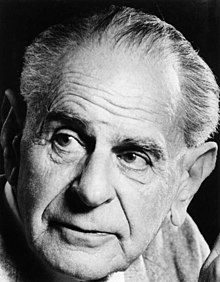
KARL POPPER
Biography
Sir Karl Popper, in full Karl Raimund Popper born July 28, 1902, Vienna, Austria, died Sept. 17, 1994, Croydon, Greater London,
Austrian-born British philosopher of natural and social science who
subscribed to antideterminist metaphysics,
believing that knowledge evolves from experience of the mind.
Philosophy
Popper coined the term "critical
rationalism" to describe his philosophy. Concerning the method of science,
the term indicates his rejection of classical empiricism, and the classical observationalist-inductivist account of science that had
grown out of it. Popper argued strongly against the latter, holding that scientific theories are
abstract in nature, and can be tested only indirectly, by reference to their
implications. He also held that scientific theory, and human knowledge
generally, is irreducibly conjectural or hypothetical, and is generated by the
creative imagination to solve problems that have arisen in specific
historico-cultural settings.
Logically, no number of positive outcomes at the level of
experimental testing can confirm a scientific theory, but a single
counterexample is logically decisive: it shows the theory, from which the
implication is derived, to be false. Popper also wrote extensively against the
famous Copenhagen interpretation of quantum mechanics. He strongly disagreed with Niels Bohr's instrumentalism and supported Albert Einstein's realist approach to
scientific theories about the universe. Popper's falsifiability resembles Charles Peirce's
nineteenth century fallibilism. In Of Clocks and
Clouds, Popper remarked that he wished he had known of Peirce's work
earlier.
Critical
rationalism is an epistemological philosophy Popper's
approach in this philosophy is based on the naturalistic idea that society has
developed through a process of solving problems using trial and error. The
natural and social sciences have been born out of such problem solving and
progressed by subjecting potential theories to vigorous testing and criticism.
Falsified theories are rejected. Popper calls for a society which is conducive
to such problem solving, a society which permits bold theorizing followed by
unfettered criticism, a society in which there is a genuine possibility of
change in the light of criticism: an open society. Popper's ideas provide a
doorway for accessing philosophical ideas and debates relevant to OR. For some
such as Boothroyd it has proved inspirational, for others such as Ulrich it has
provided a critical point of departure.
If I choose one on
his many philosophies, I choose his philosophy of science, falsification problem
induction to be exact. Among
his contributions to philosophy is his claim to have solved the
philosophical problem of induction. He
states that while there is no way to prove that the sun will rise, it is
possible to formulate the theory that every day the sun will rise; if it does
not rise on some particular day, the theory will be falsified and will have to
be replaced by a different one. Until that day, there is no need to reject the
assumption that the theory is true. Nor is it rational according to Popper to
make instead the more complex assumption that the sun will rise until a given
day, but will stop doing so the day after, or similar statements with
additional conditions. Such a theory would be true with higher probability,
because it cannot be attacked so easily: to falsify the first one, it is
sufficient to find that the sun has stopped rising; to falsify the second one,
one additionally needs the assumption that the given day has not yet been
reached. Popper held that it is the least likely, or most easily falsifiable,
or simplest theory that explains known facts that one should rationally prefer.
His opposition to positivism, which held that it is the theory most likely to
be true that one should prefer, here becomes very apparent. It is impossible,
Popper argues, to ensure a theory to be true; it is more important that its
falsity can be detected as easily as possible. Popper and David Hume agreed that there is often a psychological
belief that the sun will rise tomorrow, but both denied that there is logical
justification for the supposition that it will, simply because it always has in
the past. Popper writes, "I approached the problem of induction through
Hume. Hume, I felt, was perfectly right in pointing out that induction cannot
be logically justified."
Opinion
In my opinion, Popper always falsify
things, he always see that there is a possibility
that a thought can have a false information, but he states that there will always
be a replacement if one thing is missing. For me Popper is a great philosopher because, he is known for
his vigorous defense of liberal democracy and the
principles of social criticism that he came
to believe made a flourishing open society possible.
Very informative good job
TumugonBurahinThis article was helpful...
TumugonBurahinnice jio
TumugonBurahinNice
TumugonBurahinAmazing jio 😂
TumugonBurahinSOOOOOO INFOOOOORMAAAATIVE!!!!!!!!!
TumugonBurahinGood work Jio=)
TumugonBurahinAng lupet talaga neto. Salamat sa impormasyon
TumugonBurahinHolala😮
TumugonBurahinGood job! :)
TumugonBurahinNice one, jio. Keep it up!!!
TumugonBurahinang cute ng gawa mo pero mas cute ako. Good job men
TumugonBurahinAmazing
TumugonBurahinwew
TumugonBurahinAngas
TumugonBurahinWow nice
TumugonBurahinCute
TumugonBurahinCute
TumugonBurahinIt is very helpful. Good Work!
TumugonBurahinnice!
TumugonBurahinWawi
TumugonBurahin